

I Thought I Hated Swimming
What learning to swim again taught me about shame, running and adult beginners

I put my running kit on this morning, but I didn’t go for a run. I went for a swim instead.
And I hate swimming.
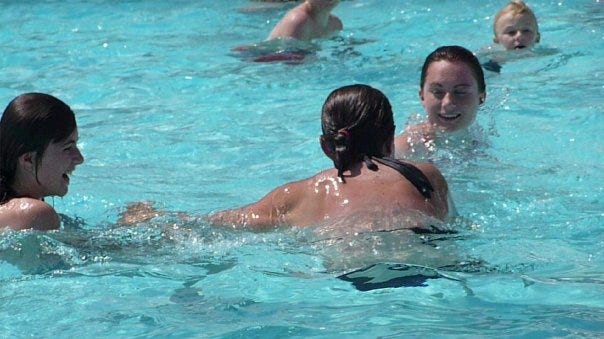
This was me, seventeen years ago, in the pool, swimming with my girls, hair wet, laughing, playing, and totally immersed in the pure joy of it. Back then it hadn’t occurred to me that I wasn’t a good enough swimmer.
Ten years ago, swimming just wasn’t part of my weekly routine, and it hadn’t occurred to me to think about improving my technique. That was until a group of my running friends wanted to make the leap from running marathons to training for triathlons. Their commitment to learn a new skill as an adult inspired me, so mainly for not wanting to feel left out, I thought, I’d give it a go.
I was offered some swimming lessons at a school’s pool and honestly, I was really excited, although a little apprehensive. I knew the dynamics of my usual teacher/student relationship would be flipped, that added a layer of vulnerability plus, heading back into a school environment as an adult learner triggers all sorts of unresolved anxieties. But, undeterred, I thought, if they can do it, so can I.
There’s nothing like the familiar, timeless smells of PE changing rooms, the combination of the strong smell of chlorine and stale damp towels took me right back to the horrors of the unapologetically unheated outdoor pool of my secondary school, weirdly advertised as an all-weather perk to prospective parents and students alike!
I half expected to be forced to wash my feet in the affectionately named “verruca pool” before I got into the pool. Do you remember those sunken troughs filled with cold water and some sort of antifungal treatment that turned your feet a beautiful yellow saffron colour? I wonder why they went.
I changed into my swimming costume, and suddenly I felt gawky and awkward and self-conscious in my very obvious adult body, as I towered over the children who’d just finished their lesson. There was no where to hide my physical presence, it was evident I was an adult in a beginner’s environment; adults were meant to be competent, but just I felt embarrassed.
I entered the pool and was asked by the teacher to demonstrate my current swimming technique. I was confident, I obliged, but then a laugh, light-hearted, flippant, well meaning. Something about how we’d just have to work with what I’d got.
I can’t remember much after that, no new moves, or techniques to help me become the swimmer’s equivalent of the running gazelle that I’d hoped for.
I felt the weight of my incompetence that I hadn’t felt in my swimming before, I was embarrassed, a bit humiliated but then came the shame.Like a hot flush, an unpleasant, uncontrollable warm wave washing over my body, moving slowly from the top of my head to the tips of my toes.
And that’s the thing about sport; there’s simply no place to hide. In life, we can just about get away with being mediocre. As a teacher, I was more satisfactory than outstanding, and that was ok, snapshot observations didn’t define my teaching ability. Thank goodness we don’t have a universal teacher’s competitive platform where segments of your lesson can be ranked against other teachers. I’d be hard-pushed to achieve any segment leaderboard or local legend status… possibly Queen of the Mountain of marking!

Yet, this tiny interaction created an unwanted identity that I hadn’t for a nanosecond even contemplated. I was a competent running coach who was suddenly revealed as an incompetent beginner, and this was an identity that, at the time, I just wasn’t ready to own.
That was until I chose a swim over a run and within the same week, I listened to a podcast where the subject of shame was discussed at length.
The host Brené Brown, from her shame research, introduced the concept of an ‘unwanted identity’, suggesting this was any characteristic, trait, or persona that directly conflicted with the vision of your ideal self. Basically, it is the specific type of person you are absolutely terrified of being perceived as. Of course, it made sense.
This is probably why, in that pool, all those years ago, I kept my shame to myself, smiled politely, but deep inside I knew full well I wouldn’t be back. The comment wasn’t unkind, it was throwaway, and I’ve no doubt I’m made many comments myself over the years that didn’t land. No, this shame was all mine, I was the one who built it, and I was the one who wasn’t prepared to wear it.
I hate swimming, right?”
And since that day I haven’t really been swimming, despite two sailing holidays with crystal clear waters, instead, I preferred the identity of hating swimming, accepting a stereotypical narrative that I’m a pool princess who simply doesn’t want to get their hair or face wet.

In fact I protested so much about my dislike for swimming that when people said to me they hate running, I didn’t push them on this. I know that I would no more thank someone who insisted I go along to their open water swim club, despite their enthusiasm that I would be ok, than have my teeth pulled out.
So now you know that for all these years, it turns out I was lying. The truth is I’ve spent years wanting to submerge my whole body, head and face into the water and feel the joy and healing power that water holds.
I also know that there are many women who have felt the same about running. Wanting nothing more than the ease of an identity to get up early on a Sunday morning, to head out for a run, smile and wave to other runners, be part of the secret club that everyone raves about but, for some, seems so hard to get into.
If you’ve ever found yourself apologising for being slow, or being the one “holding everyone up”, has it really been all about the pace, or is it because you don’t want to be seen as “the burden”, you don’t want an unwanted identity. Doing anything new as an adult beginner is terrifying, but sadly, the shame gap between I am an adult and I don’t know what I’m doing is exposed at breakneck speed in sport.
Isn’t it funny how we sub-consciously protect ourselves from feeling shame?
According to shame research (Hartling via Brene Brown), there are three stratigies that we use to protect ourselves, a behaviour that disconnect us from the shame; moving away, moving towards and moving against.
For me, my default setting was to move away from the shame of being seen as incompetance and I’ve watched many women do the same in running, they just stop turning up. Or they say I’ll get to 5k before I start your beginner’s course.
I’ve also watched women move towards the sport but as the backbone of, for example a run club, the run leader who never runs for themselves, or the back marker, always preferring to be the supporter rather than be the participant.
And the runner who moves against the shame could be the runner who mocks the beginners, is vocal in their opinions of the measly distance, or the shocked “what you’re running a half marathon?!”. It usually says more about what they’re running from than what they’re running towards.
Brene Brown, on her podcast spoke about another disconnection strategy, move within. Brown suggest shame is turned inward onto ourselves and it sport it’s the hardest part to talk about and pin down because we live in a running culture where pain and pushing through are reward. This is the runner who continues to train on an injury, comes back too soon, or restricts calories to 'look' like a runner.
I’m just touching the tip of the iceberg with this, shame isn’t something that’s openly discussed, as Brown suggests, it needs silence and secrecy to thrive.
Why choose a swim over a run?
Because I found myself really enjoying swimming again, with my daughters, no slow or fast lanes, just swimming up and down, ten minutes to start with, then 20 and now 30 mins and 1200m. I eavesdrop on the swim teachers coaching the children in the next lane, I don’t think they’ve noticed.
And because I conntected a few dots and thought about the possibility of a trigger that prevented me from doing something that, as it turns out, I love just as much as I do running!
I’m naming my shame, because that’s how shame resilience works, I’m admitting that it wasn’t swimming that I disliked at all, it was not being competent at it that made me, so vocally, avoid it.
We’re going sailing again next week, I’ve bought myself some goggles and I won’t be bobbing around.
Name your shame, say it out loud, connect your dots and see if you’re missing out on something that you might truly love. Because when you do, your shame will shrink, trust me.
one thing which really changed swimming for me was buying a swim snorkel. suddenly you can just focus on your form and it becomes really meditative. yes you get some funny looks but i recommend it.
Well that’s stirred a raft of memories I wasn’t intending to visit! I’ll add to the school pool nostalgia; cubicles made solely of plastic curtains. Makes me shudder just thinking of it! But I can remember very happy times with friends at the local pool larking around and having a splashing good time. So I’ve been living in the ‘I hate water on my face’ camp all my adult life. Connecting dots Verity, connecting all the dots! Have fun when you go sailing x